If you're getting ready to list a home on Lake Sinclair, here's a question worth asking before the sign goes in the yard: who actually owns your dock?
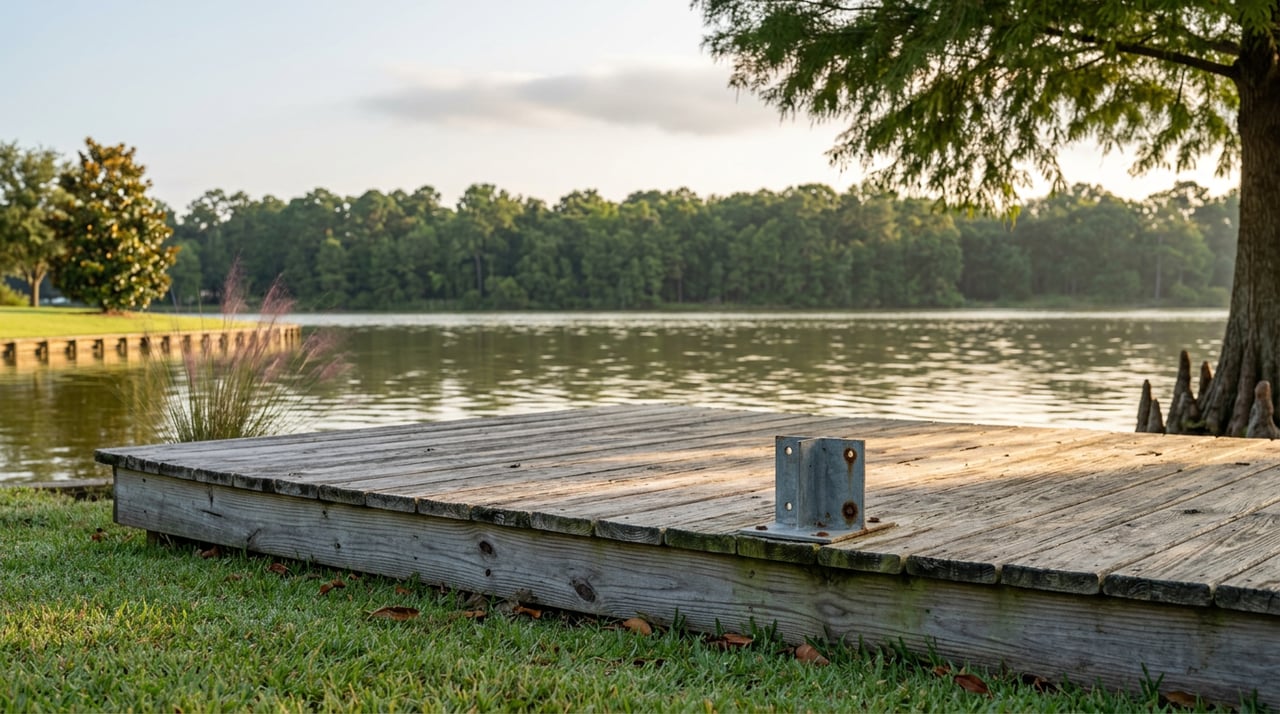
Not you, technically. The dock sits on land that belongs to Georgia Power, and your right to use it comes from an agreement the utility made with you personally, not with the house. That distinction rarely comes up until a closing date is on the calendar and a buyer's lender starts asking for paperwork nobody thought to pull together. By then, it can cost weeks.
The paperwork nobody budgets time for
Lake Sinclair was built in 1953 when Georgia Power dammed the Oconee River to run a hydroelectric station, and the U.S. Forest Service still describes it as a 15,330 acre lake with 417 miles of shoreline. That shoreline is Georgia Power property, not county land, which means the rules governing every dock, boathouse, and seawall come from a utility company operating under a federal license, not from the Baldwin County courthouse.
Most sellers know their dock adds value to the listing. Fewer know that the same structure is also the single most common reason a Lake Sinclair sale stalls between contract and closing, because the piece of paper that authorizes it belongs to a person, not a property.
An agreement with a person, not a deed right
Under its Federal Energy Regulatory Commission license, Georgia Power controls how its lake property gets used, and it does this through individual legal agreements with the property owners next to the water. Those agreements authorize a specific owner to keep a dock, boathouse, or seawall on Georgia Power land. When the house changes hands, the new owner isn't automatically part of that agreement. Georgia Power's own shoreline guidelines are direct about what stops a permit review cold:
No permit of any kind will be issued if the applicant is not a party to a current, valid agreement with Georgia Power, or if there are existing compliance issues on the lot or shoreline.
That single line does most of the work in explaining why lake closings sometimes drag. A few things can trip up a transfer before it starts:
- The seller's agreement fees aren't current
- The dock, boathouse, or seawall was altered or expanded without a permit at some point
- The property has more than one shoreline structure, since Georgia Power only allows one per lot (a dock, boathouse, or slip, or a combination built around a single walkway)
- The structure predates current guidelines and no longer conforms, which limits what can legally be done to it beyond minor repair
That last point matters more than it sounds. Georgia Power will let an older, non-conforming structure stay up under minor maintenance, but a full rebuild or a fresh agreement gets measured against today's rules, not the rules in place when it was first built. A dock that has quietly existed for twenty years without ever being questioned can still fail a compliance check the moment someone has to formally reestablish the agreement.
Unauthorized work carries a real penalty too. Georgia Power can suspend a property's ability to get any lake use permit for up to five years if construction happens without prior written approval, whether that work was done by the owner or a contractor. If a seller discovers an old, unpermitted addition during pre-listing prep, that's not a footnote. It's a decision point.
The maintenance window built into the calendar
There's a practical upside buried in all of this. Most years, Georgia Power schedules a seasonal drawdown that temporarily lowers Lake Sinclair, and local reporting on past drawdowns has described the purpose plainly: it lets lot owners schedule repairs and construction on docks, seawalls, and boathouses that would otherwise sit underwater at full pool.
For a seller, that seasonal window is the natural time to get ahead of a compliance problem rather than discover it after an offer is already on the table. Waiting until a buyer's due diligence period to find out a permit lapsed, or that a boathouse extension was never approved, turns a fixable issue into a closing delay.
What the disclosure form actually asks
Georgia is a caveat emptor state, which means state law doesn't require a seller to fill out a formal disclosure form at all. Most sellers still complete one anyway, because their agent recommends it and because Georgia law separately requires honest answers to a buyer's direct questions.
The standard Georgia Association of REALTORS form asks about additions, alterations, and whether any work was done without required permits or in violation of code or zoning rules. It asks the same kind of question about a home's water source and septic system. A dock that was extended without Georgia Power's sign-off and a septic system that was never inspected after a repair sit in the same category on that form: known issues a seller is expected to speak to honestly, permit or no permit.
Baldwin County's dense red clay soil requires specialized drain field design and percolation testing, and a local contractor, Milledgeville Septic, notes that permitting for a new or replacement system typically runs a few weeks before installation can start. Wells go through a parallel process at the Baldwin County Environmental Health Department, which requires a site evaluation and permit before a well can be installed and recommends annual water testing afterward.
None of that is exotic information. It's the kind of thing a seller in town rarely has to think about and a seller on the lake almost always does.
A pre-listing checklist, roughly by lead time
| Item | Who handles it | Rough lead time |
|---|---|---|
| Confirm dock/boathouse agreement is current and fee-paid | Georgia Power's Oconee/Sinclair Lakes Resources Office in Eatonton | Days to a few weeks, depending on compliance history |
| Address any unpermitted structure or expansion | Georgia Power shoreline permit review | Weeks, longer if the structure needs to be brought into conformance |
| Septic inspection or repair permit | Licensed local installer, Baldwin County | Several weeks including permit and inspection |
| Well testing | Baldwin County Environmental Health Department | Days for testing, ongoing for annual disinfection records |
| Dock and seawall repairs | Timed to the seasonal drawdown | Weather dependent, typically a fall or winter window |
None of these are large jobs on their own. Stacked together and discovered late, they're the difference between a closing that happens on schedule and one that slips a month.
What this means for price and timeline
A dock in good standing is a genuine selling point on Lake Sinclair, and buyers know it. What often gets missed is that the same feature carries a paperwork trail that doesn't disappear at closing, it just changes hands, and the new owner has to be eligible to receive it. A seller who confirms that eligibility before listing is offering a cleaner transaction, not just a nicer photo of the water. A seller who doesn't is gambling that no one asks the question until it's their problem to solve under contract, with a deadline attached.
A few quick answers
Does the dock permit transfer automatically when I sell? No. The agreement is between Georgia Power and the property owner, and a new owner has to be a party to a current, valid agreement before Georgia Power will authorize the structure.
What if my dock was expanded years ago without a permit? Georgia Power's rules allow older structures to continue under minor repairs, but anything beyond that gets evaluated against current guidelines, which may mean bringing it into compliance before a sale closes cleanly.
Do the same rules apply to a seawall, or just docks? Any shoreline structure, including seawalls and boathouses, requires written authorization from Georgia Power. There's no separate, lighter-touch category for seawalls.
Does any of this matter if my home isn't on the water? The dock rules are specific to Georgia Power shoreline property. Septic and well permitting through Baldwin County applies to any home on those systems, waterfront or not.
If you're weighing a sale on Lake Sinclair or anywhere else in Baldwin County, it helps to have someone walk the permit and paperwork side of it with you well before a buyer ever sees the listing. Carla Bentley has spent years working these exact transactions in Milledgeville and around the lake. Let's Connect and figure out what your home needs before it hits the market.